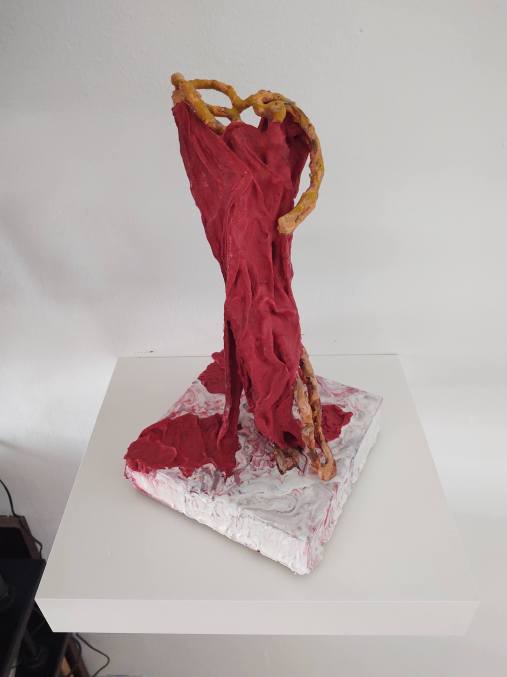
Passion
Wax on Panel with Steel Wire and Plaster Cloth, 2023
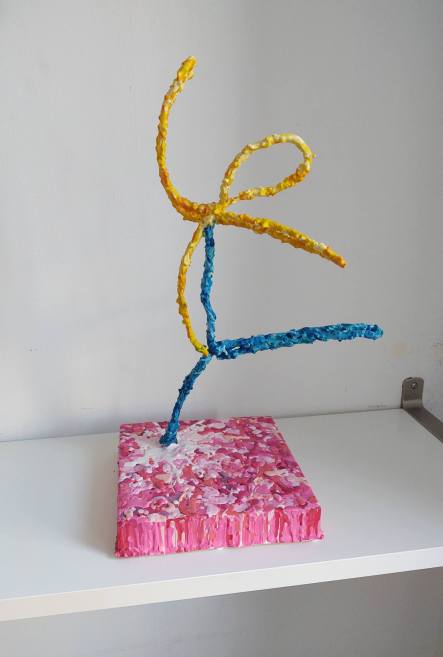
Joy
Wax on Panel with Steel Wire and Plaster Cloth, 2023
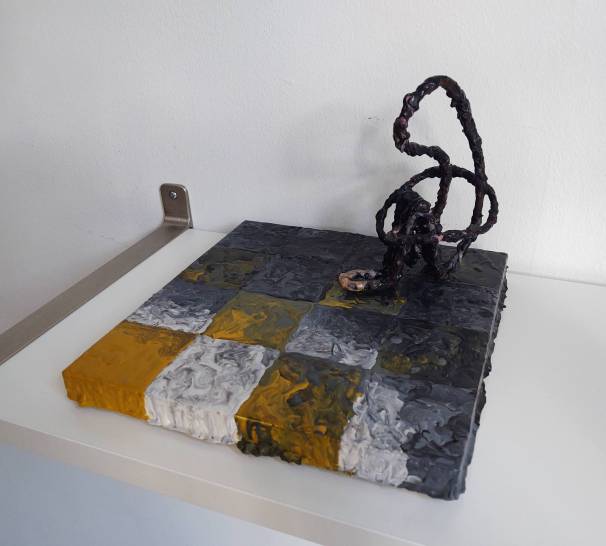
Don’t Ever Go to School in Texas
Wax on Panel with Steel Wire and Plaster Cloth, 2022
Last spring after the leak of the draft SCOTUS opinion overturning Roe v. Wade, one of the first thoughts I had was about all of the high school students who, in accepting offers of college admission, would unwittingly be signing away their fundamental right to bodily autonomy by going to college in a state where abortion would become illegal. For those going to school in Texas, even if they were to come home to Illinois for an abortion, they would still make themselves vulnerable to a $10,000 fine if a Texas vigilante ever found out and turned them in.
Gun Violence
The horror of gun violence is a daily part of life in 21st century America. Mass shootings dominate the headlines, traumatize our communities and add an element of fear and uncertainty into everyday tasks such as going to school or buying groceries at the store. Gun violence also has a long history in our country, including violence committed by the government itself. The sculptures in this collection explore the individual and communal tragedy inflicted by this uniquely American phenomenon.
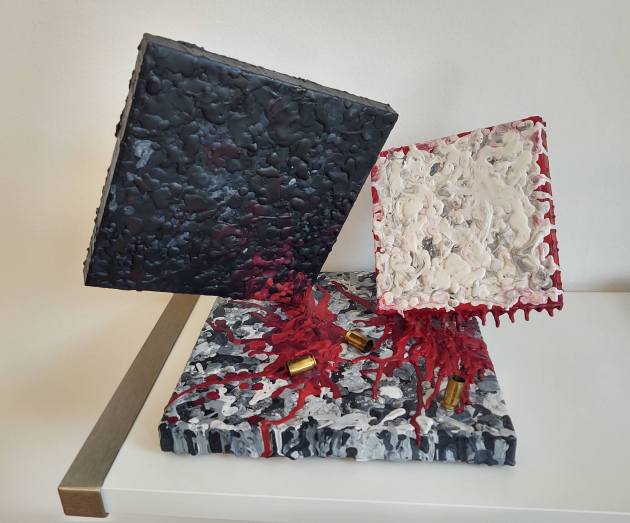
Independence Day
Wax on Panel with Brass Bullet Shells, 2022
The July 4, 2022 shooting in Highland Park, IL hit very close to home. Many of my friends, students and their families are from Highland Park and were deeply affected by this tragedy that saw 7 people killed and 48 others wounded. What many people don’t know is that the July 4th weekend also saw tragic gun violence on the South and West sides of Chicago. Over the course of the weekend, 10 people were killed and 62 others were shot, including two mass shootings. Despite being only 30 miles apart, the shootings in the city didn’t receive nearly the same coverage from the national news media, let alone a visit from the Vice President. This piece explores that discrepancy.
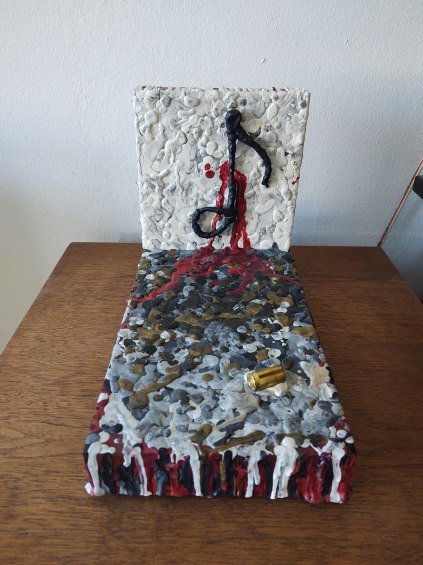
The Execution of Joe Hill
Wax on Panel with Steel Wire, Plaster Cloth and Brass Bullet Shell, 2022
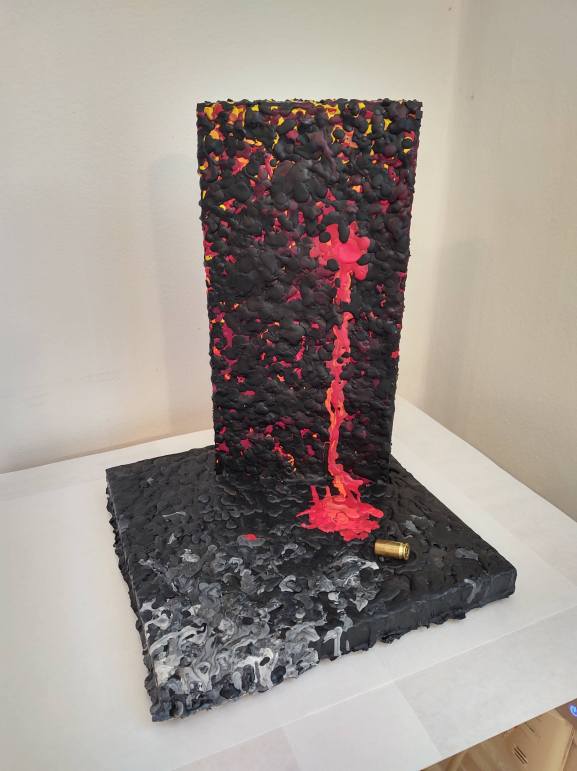
Revelation Lost
Wax on Panel with Brass Bullet Shell, 2022
The Torah teaches that humans are created in the image of God. That spark of godliness allows for the possibility of Revelation to flow through each one of us. So when a person is killed by gun violence, it is not only a life that is lost, but the possibility of Revelation.
Revelation
Revelation lies at the heart of the Jewish experience. Although the giving of the Torah at Mount Sinai stands as the central moment of revelation in our tradition, revelatory encounters with God occur throughout the Bible, and some would say they continue until this day.
The following pieces, along with my Revelation Lost sculpture above, explore different ways the Jewish people have experienced revelation. Some have been personal encounters with the Divine that have shaped individuals’ life trajectories. Others have been foundational, communal experiences that have molded us as a people.
The exact nature of revelation remains an open question. Is revelation a one-way flow of words and ideas from Heaven to Earth? Or does human experience shape the content of revelation? Is revelation something one hears? Or is it experienced using other senses? Are the accounts of revelation found in our texts to be understood as literal descriptions? Or do these texts merely hint at larger, ineffable truths that can be understood by the soul but never fully captured in words?

Pillar of Fire
Wax on glass, 2020
When God took the Israelites out of slavery in Egypt, God’s Presence led them through the wilderness. Exodus 13:21-22 tells us that “the Lord went before them in a pillar of cloud by day, to guide them along the way, and in a pillar of fire by night, to give them light, that they might travel day and night. The pillar of cloud by day and the pillar of fire by night did not depart from before the people.”
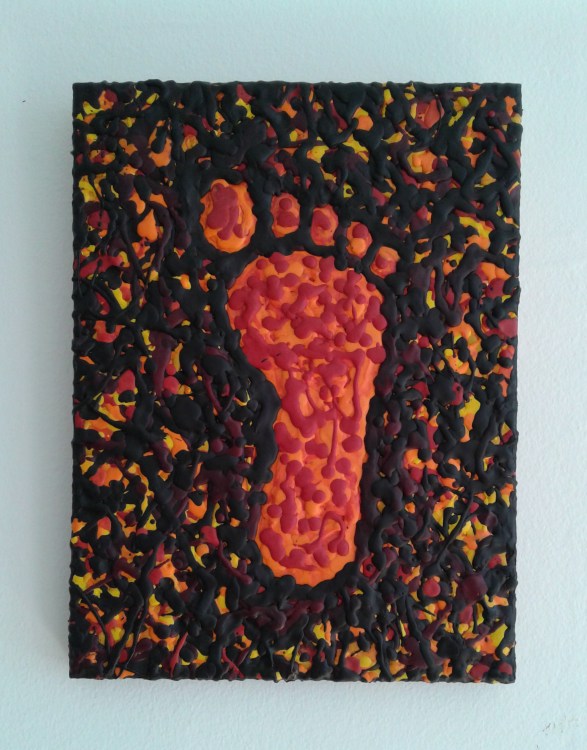
Holy Ground
Wax on Panel, 2019
This piece draws inspiration from two different Biblical scenes with nearly identical language. In the third chapter of Exodus, when Moses first encounters God at the Burning Bush, God instructs Moses: “Do not come closer. Remove your sandals from your feet, for the place on which you stand is holy ground.” (Exodus 3:5). Later, when the Israelites first enter the land of Canaan, Joshua comes across a “captain of the Lord’s host” who instructs him: “Do not come closer. Remove your sandals from your feet, for the place on which you stand is holy ground.” (Joshua 5:15)
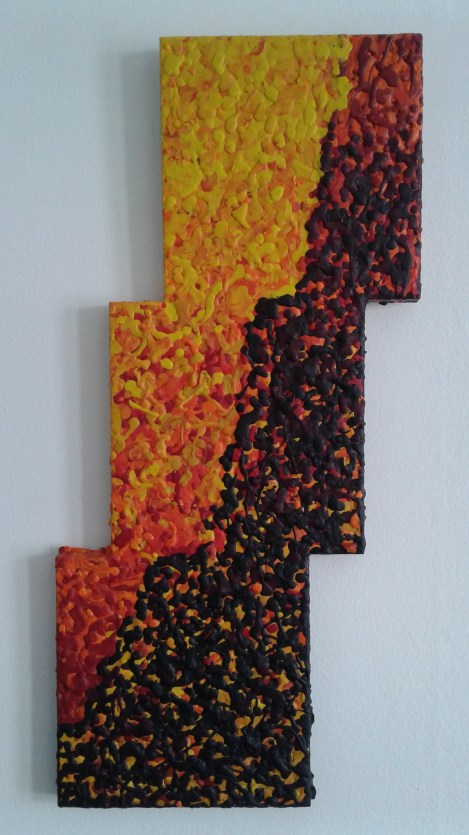
Revelation at Sinai
Wax on Panel, 2019
In this series, the orange/red combination reflects the revelatory element of the piece. Here, the color shows up both at the top of the mountain, where God has come down to reveal the Torah, as well as at the bottom of the mountain where the people are, speaking to the role that we play in the ongoing unfolding and revelation of Torah.
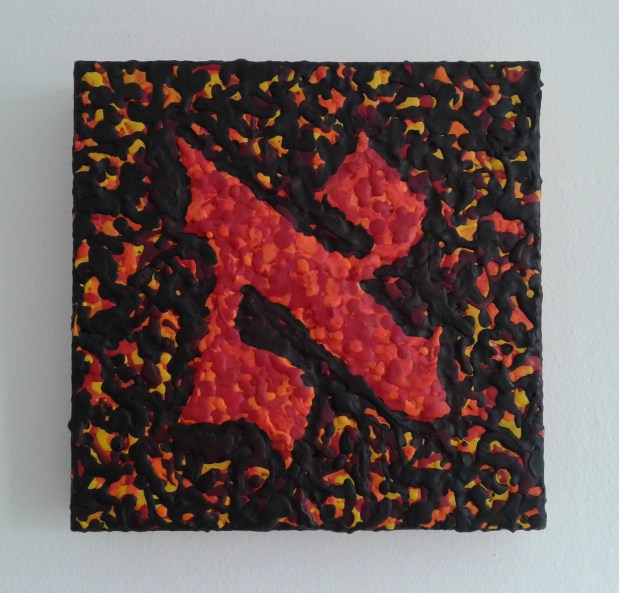
Silence
Wax on Panel, 2019
Rabbi Naftali Tzvi Horowitz of Ropshitz (d.1827) taught in the name of his teacher R. Menachem Mendel of Rymanov (d. 1815) that it is possible that the only thing the Israelites heard directly from God on Mt. Sinai was the letter aleph at the beginning of the first word of the Ten Commandments. Paradoxically, the letter aleph, represented in this piece, is a silent letter, suggesting that the power of the revelation came not from the content of the revelation, but from the overwhelming experience of encountering God.
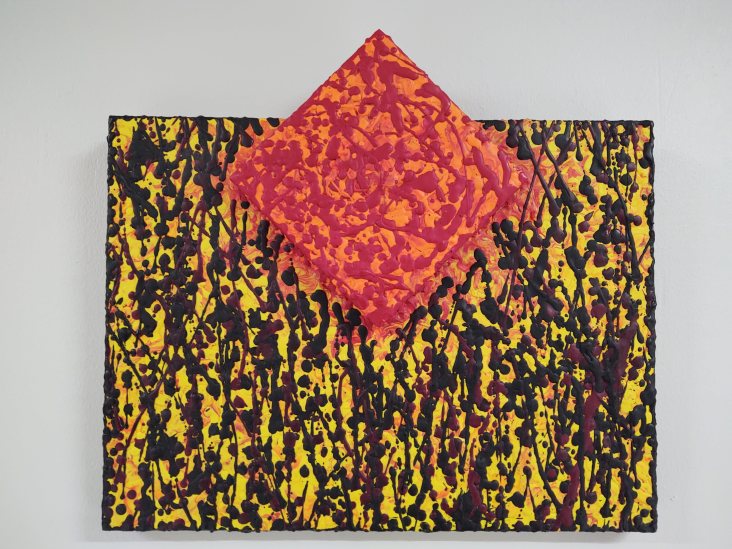
Holy of Holies
Wax on Panel, 2019
At the heart of ancient Israelite civilization stood God’s “house,” the Mishkan (Tabernacle), the portable temple that the Israelites used to worship God before the construction of the permanent Temple in Jerusalem. The Mishkan contained two rooms: an outer vestibule and the inner sanctum, the Holy of Holies, separated from each other by a colorfully woven curtain. Inside the Holy of Holies sat the Ark of the Covenant, a wooden box covered in gold on whose cover stood two golden keruvim (winged angels). The Ark housed the stone tablets of the Ten Commandments, containing God’s revelation from Mount Sinai. But even more importantly, the Ark served as God’s “throne” from which God could engage in more intimate revelation to Moses as described in Numbers 7:89: “When Moses went into the Tent of Meeting to speak with God, he would hear the Voice addressing him from above the cover that was on top of the Ark of the Pact between the two keruvim; thus God spoke to him.”
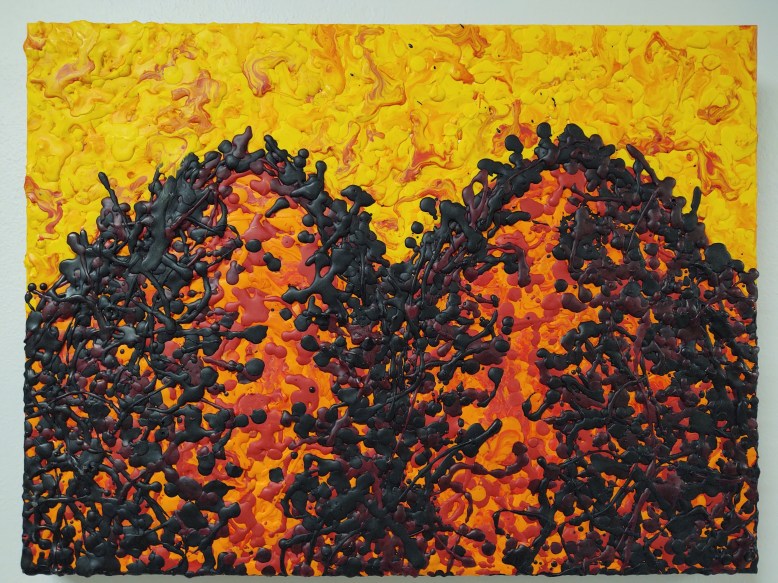
Shnei Luchot HaBrit (Two Tablets of the Covenant)
Wax on Panel, 2019
When Moses came down from Mount Sinai, he brought with him two stone tablets containing the Commandments that God had proclaimed to the Israelites. The Torah tells us that the text on these tablets was “inscribed with the finger of God.” (Exodus 31:18) The rabbis proposed numerous interpretations of what this meant, including that the writing went all the way through the stone, yet could be read correctly from both sides. Yet no sooner had Moses brought down these stones containing God’s Revelation than he smashed them on the ground in disgust at the people’s worship of the Golden Calf.
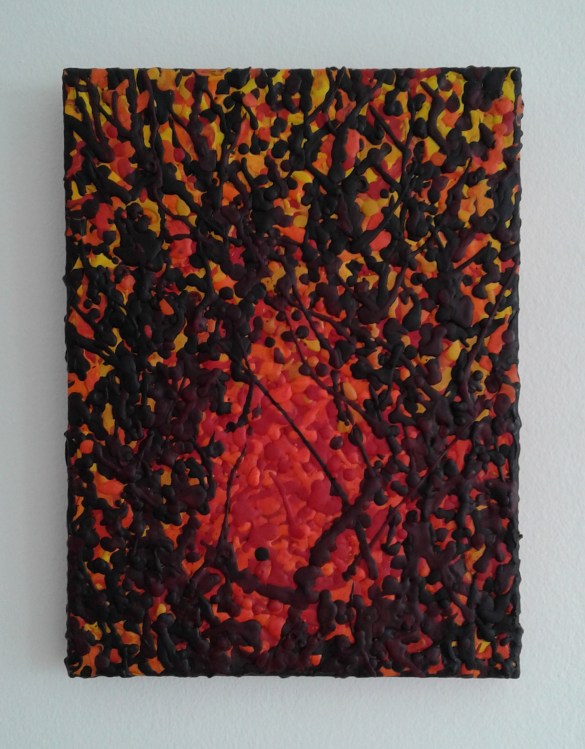
The Burning Bush
Wax on Panel, 2018
“Now Moses, tending the flock of his father-in-law Jethro, the priest of Midian, drove the flock into the wilderness, and came to Horeb, the mountain of God. An angel of the LORD appeared to him in a blazing fire out of a bush. He gazed, and there was a bush all aflame, yet the bush was not consumed. Moses said, ‘I must turn aside to look at this marvelous sight; why doesn’t the bush burn up?’ When the LORD saw that he had turned aside to look, God called to him out of the bush: ‘Moses! Moses!’ He answered, ‘Here I am.’” (Exodus 3:1-4)
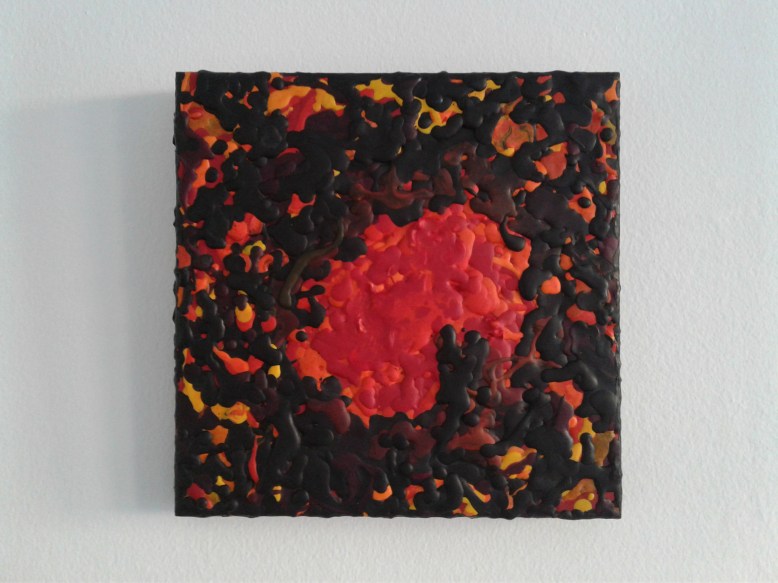
Ner Tamid (Eternal Light)
Wax on Panel, 2018
In Exodus 27, the Israelites are instructed to bring olive oil to the Tabernacle to keep a continual light (ner tamid) burning in the sanctuary. This light illuminated the space just outside the Holy of Holies from where God would speak directly to Moses. In later Jewish practice, the Ner Tamid became a separate light in the synagogue that glows above the ark where the Torah scrolls are housed. The Talmud, on Shabbat 22b, suggests that the continually burning light in the sanctuary symbolizes God’s presence among the Jewish people.
Abstract Designs
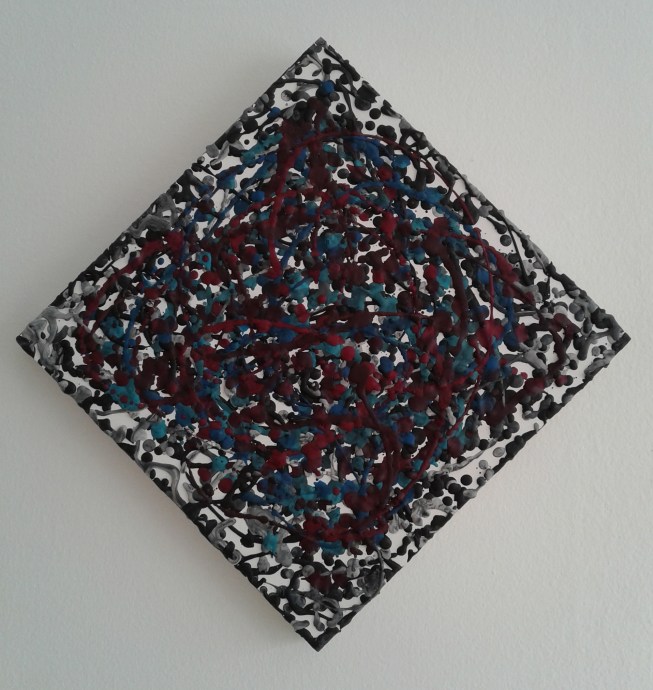
Wax on Panel, 2018
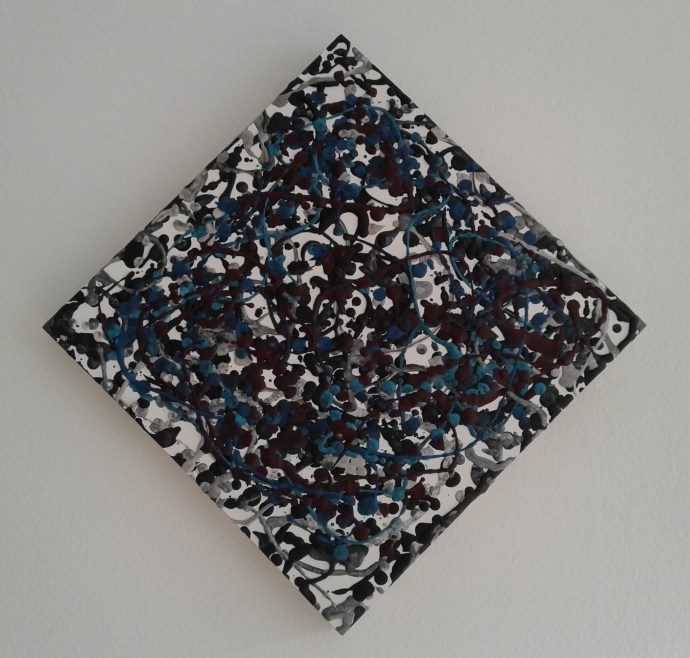
Wax on Panel, 2018
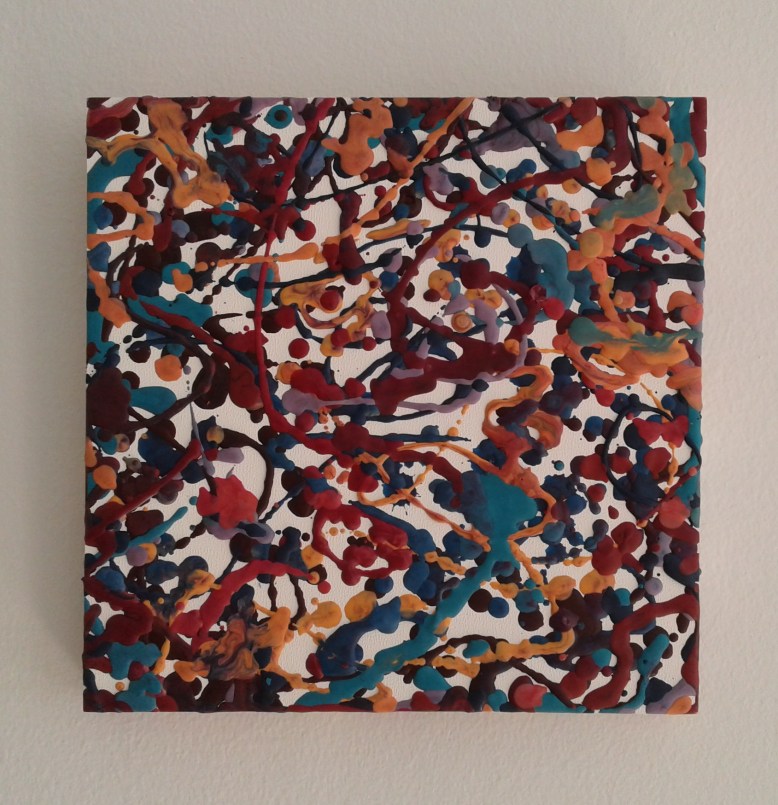
Wax on Panel, 2018
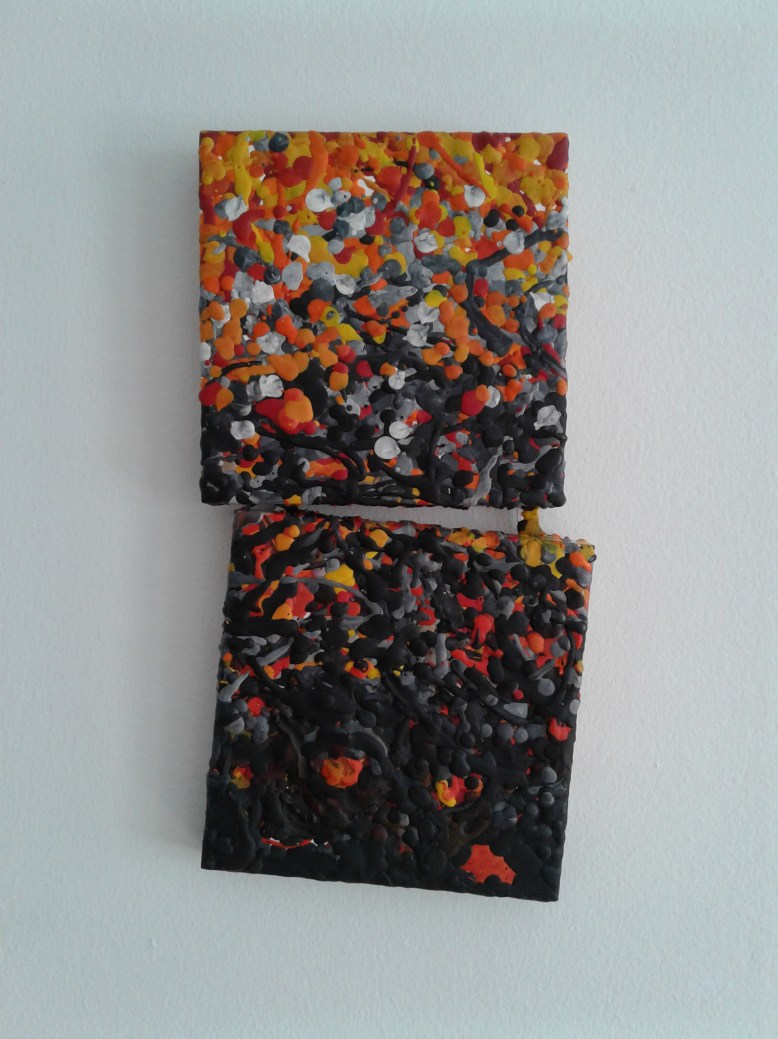
Therapy
Wax on Panel, 2018
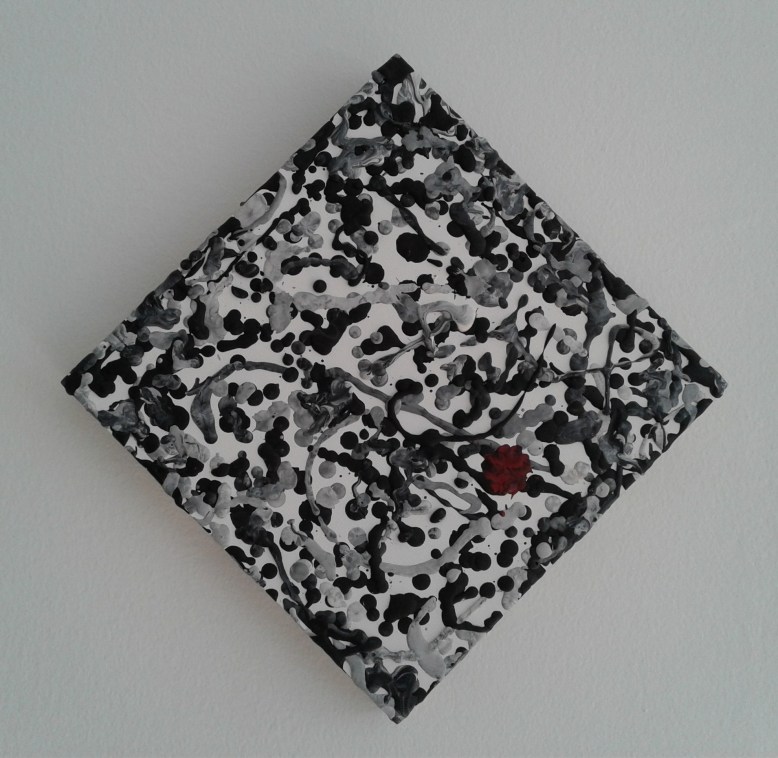
Wax on Panel, 2018
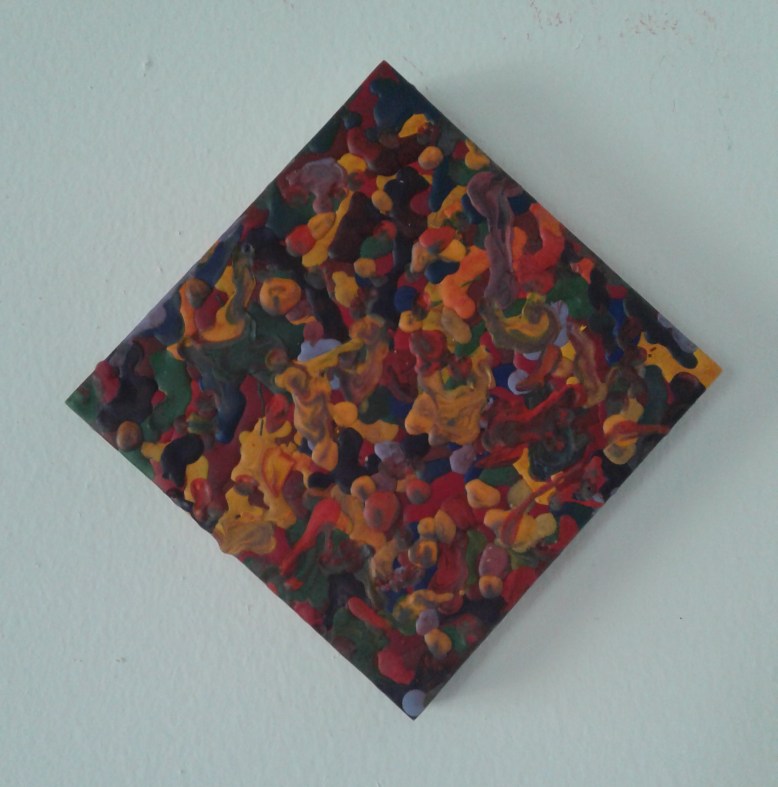
Wax on Panel, 2018
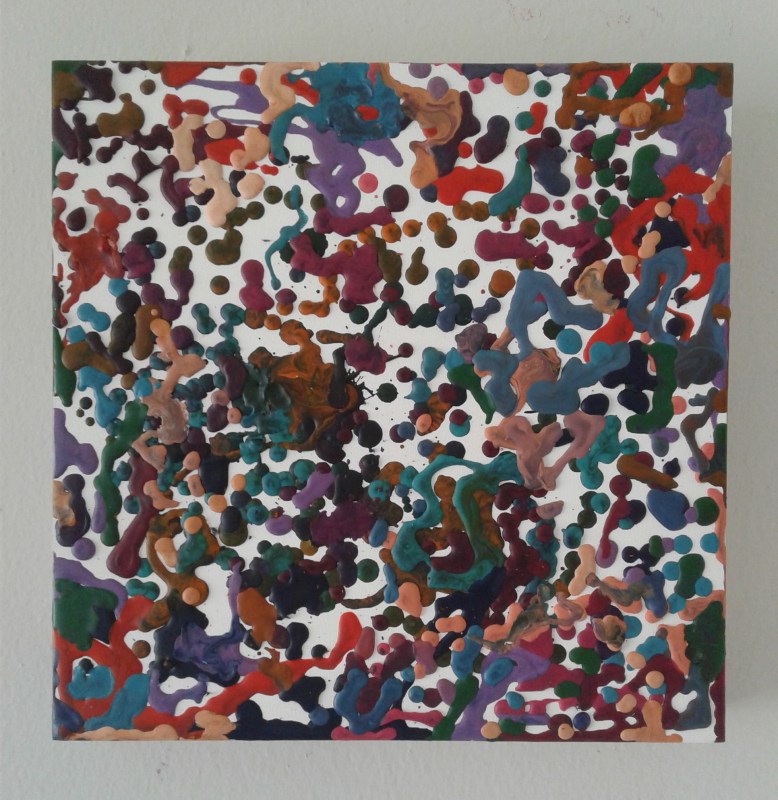 Wax on Panel, 2018


Wax on Canvas, 2018
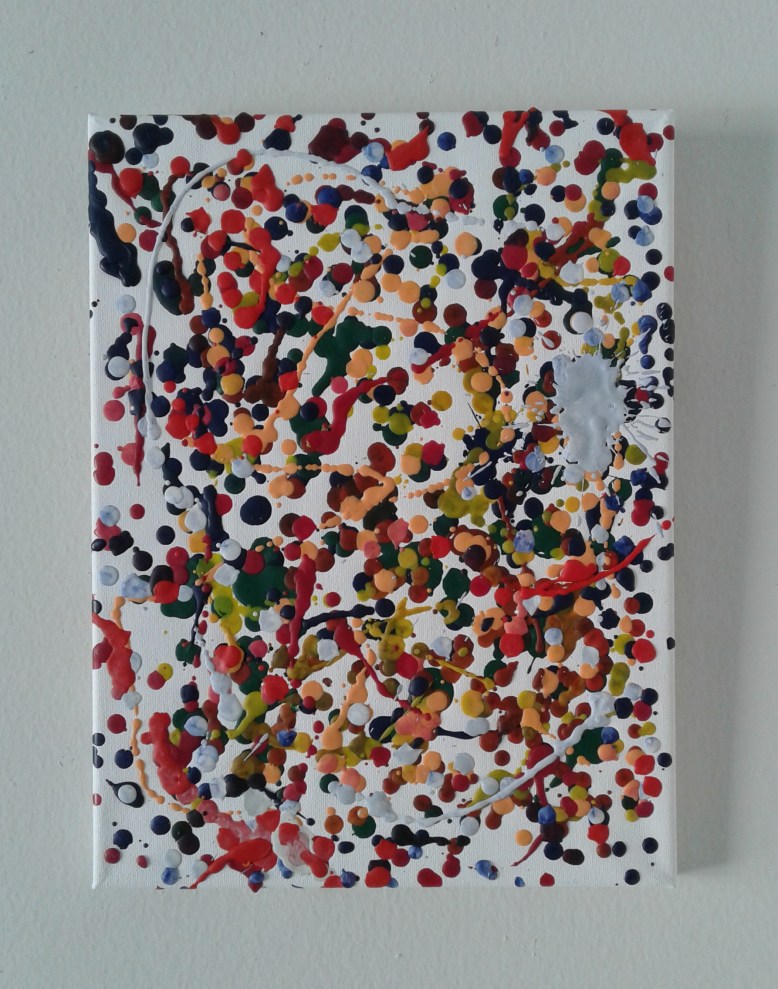 Wax on Canvas, 2018
 Pete Stein